From Chromebook to Googlebook: Google's Shift to AI-Powered Android Laptops
The End of an Era: Chromebook's Legacy
For 15 years, Google championed the Chromebook as a lightweight, browser-based computing solution, dominating the education market with its simplicity and security. However, the company has now acknowledged that a browser alone cannot meet modern computing demands. At the Android Show on Monday, Google made a paradigm shift by killing the Chromebook in favor of a new premium laptop category: the Googlebook. These devices mark a radical departure, running Android with Gemini AI deeply integrated at the operating system level. The move reflects a broader industry trend toward AI-native hardware, where the cursor itself becomes an intelligent agent. This article explores what led to this decision, the capabilities of the Googlebook, and what it means for users and the market.
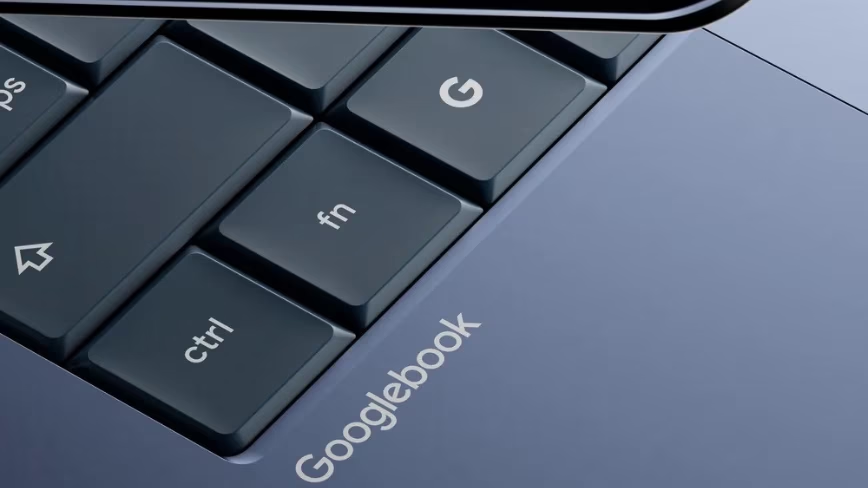
Introducing Googlebook: The AI-First Laptop
The Googlebook is not just a rebranded Chromebook; it is a completely new category of premium laptops. Unlike Chrome OS, which relies on web apps, these devices run Android natively, leveraging Google's vast app ecosystem. The key differentiator is the integration of Gemini—Google's advanced AI model—directly into the operating system. This enables the cursor to function as an AI agent that can understand context, predict user actions, and automate tasks across the interface. During the unveiling, Google demonstrated how the cursor can summarize documents, generate images, and even control multiple applications simultaneously through natural language commands. The devices are scheduled to ship in autumn, targeting professionals and creators who need both power and intelligence.
Gemini at the Core: How the AI Agent Works
At the heart of the Googlebook is a persistent AI layer that transforms the ordinary cursor into an interactive assistant. When you hover over text, the AI can suggest edits; when you select an image, it can generate variations or remove backgrounds. This goes beyond typical voice assistants—the AI understands your workflow by analyzing on-screen content and your interaction patterns. For instance, if you are writing an email, the cursor might offer to draft replies or schedule meetings based on calendar data. Google emphasized privacy by keeping most processing on-device, with optional cloud enhancements. This makes the Googlebook a powerful tool for multitasking, especially for users who juggle numerous tabs and apps.
A Premium Leap: Hardware and Design
To support these AI capabilities, Googlebook laptops come with high-end specifications: Intel Core Ultra or AMD Ryzen processors, up to 32GB of RAM, and dedicated neural processing units (NPUs) for AI tasks. The displays are OLED or mini-LED with high refresh rates, and the chassis are made of aluminum or carbon fiber. Pricing is expected to start at $1,299, placing them in direct competition with MacBook Pros and Windows premium Ultrabooks. Google also introduced a stylus with haptic feedback, optimized for drawing and note-taking with AI enhancements. The shift from budget Chromebooks to premium Googlebooks signals that Google is targeting a different demographic—one willing to pay for intelligence and performance.
Android Ecosystem Unleashed
By adopting Android, the Googlebook gains access to over 3 million apps, including professional tools like Adobe Photoshop and Microsoft Office. Unlike Chrome OS's limited Linux support, Android offers better compatibility with mobile and desktop applications. Google has also optimized the interface for larger screens, adding a desktop mode with resizable windows, a taskbar, and multiple desktops. The integration with Gemini ensures that apps can share data and actions seamlessly. For example, you can drag an image from a browser into a document while the AI automatically adjusts formatting. This creates a unified experience that Chrome OS never achieved.

What This Means for the Laptop Market
The Googlebook's arrival challenges the traditional laptop categories. Apple's MacBook has long relied on tight hardware-software integration, while Windows PCs dominate enterprise. Google's strategy is to leverage AI as a differentiator—something neither Apple nor Microsoft has done at this deep OS level. However, the biggest impact may be on Chrome OS itself. With the discontinuation of new Chromebooks (though existing models will receive updates for now), Google essentially admits that the browser OS model has reached its limit. This could lead to a fragmentation in the education sector, where Chromebooks are ubiquitous, but Googlebook's premium pricing may not replace them. Instead, Google might keep a low-cost Android laptop line for schools while focusing the Googlebook on high-end users.
The Future of AI Laptops
By embedding AI into the cursor, Google has set a new standard for human-computer interaction. Future updates could allow the AI agent to learn user habits, anticipate needs, and even execute multi-step processes independently. Analysts predict that other manufacturers will adopt similar AI-on-chip architectures. For consumers, the Googlebook represents a glimpse into a world where the computer understands not just commands but intent. As Google moves away from the Chromebook legacy, it bets that the next decade of computing will be defined not by the browser, but by the intelligent cursor.
In summary, the Googlebook is more than a new laptop—it is a statement that AI has become the new operating system. With a scheduled autumn launch, the true test will be whether users embrace this AI-first approach. If successful, Google will have killed the Chromebook only to birth a more powerful, albeit more expensive, computing paradigm.
Related Articles
- Firmware Update Blocks Home Assistant: Tapo L530 Smart Bulb Integration Fix Revealed
- NVIDIA and ServiceNow Unleash Next-Generation Autonomous AI Agents for Enterprise Operations
- Breaking: Cybersecurity Shifts from Signature Matching to Context-Aware AI Intrusion Detection
- 10 Keys to Running a Prepersonalization Workshop That Works
- Uber Unveils Plan to Turn Its Driver Fleet into a Massive Sensor Network for Autonomous Vehicle Development
- 7 Game-Changing Insights from the Humanoid Robot That Won a Marathon Using Smartphone Tech
- ByteDance Unveils Astra: A Two-Brain System for Robot Navigation in Complex Indoors
- EnterpriseClaw: Bringing Secure Governance to Autonomous AI Agent Deployments