From Sea of Nodes to Turboshaft: A Modern V8 Compiler Transition Guide
Overview
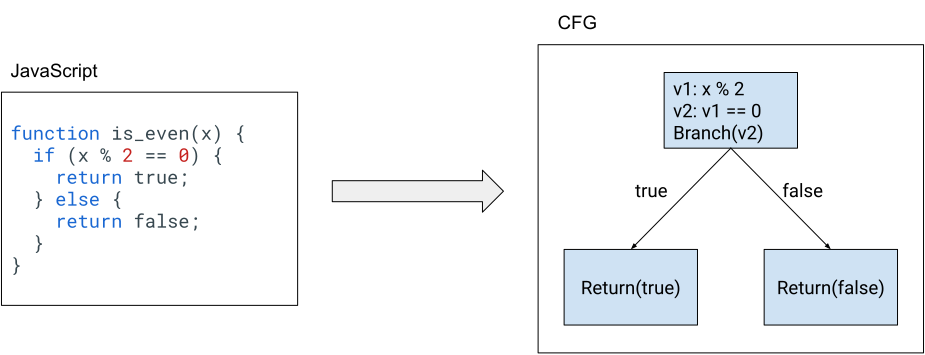
V8's top-tier optimizing compiler, Turbofan, has long been a standout example of a production compiler using a Sea of Nodes (SoN) intermediate representation (IR). However, beginning around 2020, the V8 team started moving away from SoN toward a more traditional Control-Flow Graph (CFG) IR called Turboshaft. Today, Turboshaft handles all of V8's WebAssembly compilation and the JavaScript backend of Turbofan, with only a few legacy parts still using SoN. This detailed guide explains the reasons behind this major architectural shift, walks through the evolution step by step, and highlights lessons learned for compiler designers.
Prerequisites
- Basic understanding of compiler architecture (frontend, backend, intermediate representations).
- Familiarity with V8's historical compilers: Crankshaft and Turbofan.
- Knowledge of control-flow graphs (CFG) and data-flow graphs (DFG) is helpful.
- No prior experience with Sea of Nodes required—we'll explain it.
Step-by-Step Guide: Understanding the Transition
Step 1: The Crankshaft Era and Its Limitations
Twelve years ago (2013), V8's sole optimizing compiler was Crankshaft, which used a traditional CFG-based IR. Crankshaft delivered impressive performance gains but accumulated technical debt over time. Key limitations included:
- Excessive hand-written assembly – Every new IR operator required manual assembly code for all four supported architectures (x64, ia32, arm, arm64). This made development slow and error-prone.
- Poor asm.js support – As asm.js emerged as a high-performance JavaScript target, Crankshaft struggled to optimize it effectively.
- No control-flow in lowerings – Control flow was fixed at graph-building time. You couldn't lower a high-level operation like
JSAddinto a conditional that checks types and delegates to different code paths. This severely limited optimization opportunities. - Try-catch unsupported – Despite months of effort by multiple engineers, Crankshaft could not handle try-catch blocks, a critical language feature.
- Performance cliffs and bailouts – Using certain features or edge cases could cause a 100x performance drop, making performance unpredictable for JavaScript developers.
- Deoptimization loops – Crankshaft would speculatively optimize, then deoptimize when assumptions failed, but then re-optimize with the same assumptions, leading to infinite loops and degraded performance.
Step 2: The Birth of Turbofan and Sea of Nodes
In response, the V8 team designed Turbofan with a Sea of Nodes IR. SoN is a graph-based representation where nodes represent both operations and data dependencies, and control flow is embedded implicitly via special nodes. This allowed:
- Easy introduction of control flow during lowering (e.g., lowering
JSAddinto a type-check branch thenStringAddor number addition). - Unified data and control dependencies.
- Better support for try-catch via opaque control-flow edges.
Yet, as we'll see, SoN introduced its own set of challenges.
Step 3: Identifying Issues with Sea of Nodes
Despite its elegance, SoN in Turbofan suffered from several practical problems:
- Compiler complexity – The graph was hard to debug and optimize because control and data flow were intertwined. New engineers faced a steep learning curve.
- Memory and compile-time overhead – SoN graphs tended to be larger and more expensive to work with than CFGs.
- Limited tooling – Existing compiler infrastructure (analyses, passes) was designed for CFGs; adapting it to SoN was painful.
- Interaction with other compilers – V8's stack now had multiple compilers: frontend compilers (Sparkplug, Maglev) used CFGs, while Turbofan used SoN. This mismatch made it hard to share analyses and pass results across compilers.
Step 4: The Transition to Turboshaft
Starting around 2020, the team began developing Turboshaft—a new CFG-based IR that replaces Turbofan's SoN. The rationale was straightforward: a CFG is simpler, faster to process, and more compatible with the rest of V8's compiler ecosystem. The transition has been gradual:
- Phase 1: JavaScript backend – Turboshaft took over the low-level code generation part of Turbofan's JavaScript pipeline.
- Phase 2: WebAssembly – The entire Wasm compilation pipeline now uses Turboshaft, benefiting from its simplicity and speed.
- Phase 3: Builtins – The builtin pipeline (e.g., Array methods) is being migrated from SoN to Turboshaft.
- Phase 4: Frontend – Maglev, another CFG-based IR, is replacing the SoN frontend in Turbofan for JavaScript.
By summer 2024, only a few remnants of SoN remain, and those are being phased out.
Step 5: Practical Implications for Compiler Designers
From this case study, we can extract actionable lessons:
- Prefer simplicity – A tried-and-true CFG may be more maintainable than an exotic IR, especially for large teams.
- Consider the entire toolchain – The IR should integrate well with existing passes, debuggers, and profilers.
- Don't underestimate onboarding – If your IR is hard to understand, new contributors will struggle.
- Balance expressiveness with efficiency – SoN offered flexibility, but at the cost of compile-time and memory. Turboshaft trades some flexibility for speed and simplicity.
Common Mistakes
- Assuming SoN is universally better – While SoN provides elegant solutions for some problems (e.g., control flow in lowerings), it can introduce unnecessary complexity for other parts of the pipeline.
- Underestimating the cost of changing IR – Migrating from SoN to CFG was a multi-year effort. Teams should carefully evaluate the long-term costs before adopting a novel IR.
- Ignoring legacy compatibility – V8 had to maintain both IRs during the transition, doubling testing and maintenance overhead.
- Overlooking deoptimization interactions – In Crankshaft, deoptimization loops were a nightmare. SoN improved this, but Turboshaft's CFG had to handle speculations correctly from the start.
Summary
V8's journey from Crankshaft to Sea of Nodes to Turboshaft illustrates a critical trade-off in compiler design: expressive power versus simplicity and maintainability. Turboshaft’s CFG-based IR has proven more practical for modern V8, reducing compile times, lowering the barrier for new developers, and integrating seamlessly with the compiler stack. The transition is now nearly complete, with only a few legacy paths still using SoN. For compiler engineers, the key takeaway is to choose an IR that balances your project's long-term needs—and be willing to pivot when that balance shifts.
Related Articles
- Wind and Solar Heartlands Now Represented by Party Seeking to Scrap Renewables
- Streamlining Consumer Dataset Migrations with Background Coding Agents at Spotify
- 10 Key Insights Into Lotus's Canadian EV Delivery and Geely's Strategic Move
- Sardinia's Renewable Energy Revolt: 210,000 Signatures Force Moratorium
- Walmart and ABB Launch 400 kW Ultra-Fast EV Chargers: Phoenix First to Get 7 Stations in Nationwide Rollout
- How to Choose and Evaluate an Ultra-Light Cargo E-Bike: A Deep Dive into the JackRabbit MG Cargo
- How to Refresh Your Desktop with Free May 2026 Wallpapers: A Step-by-Step Guide
- How to Build a Mega Solar Farm: A Step-by-Step Guide from Panel Installation to Commissioning