How to Create a User-Friendly Man Page with Cheat Sheet Elements
Introduction
Man pages are the backbone of Unix documentation, but they often suffer from information overload and poor navigation. This guide will show you how to transform a dense, alphabetical man page into a clear, cheat-sheet-friendly reference that users love. By adding an Options Summary table, grouping options by category, and including a compact cheat sheet, you can make your man page as useful as a quick-reference card. These techniques draw inspiration from real-world examples like rsync, strace, and Perl's perlcheat man page.
What You Need
- Access to your man page source file (e.g., .pod, .txt, or .roff)
- A text editor (vim, emacs, or any plain-text editor)
- Familiarity with man page formatting macros (or a willingness to learn basic nroff/troff)
- The original man page you intend to improve
- Optional: a list of common user questions or frequent look-ups
Step-by-Step Guide
Step 1: Analyze Your Current Man Page Structure
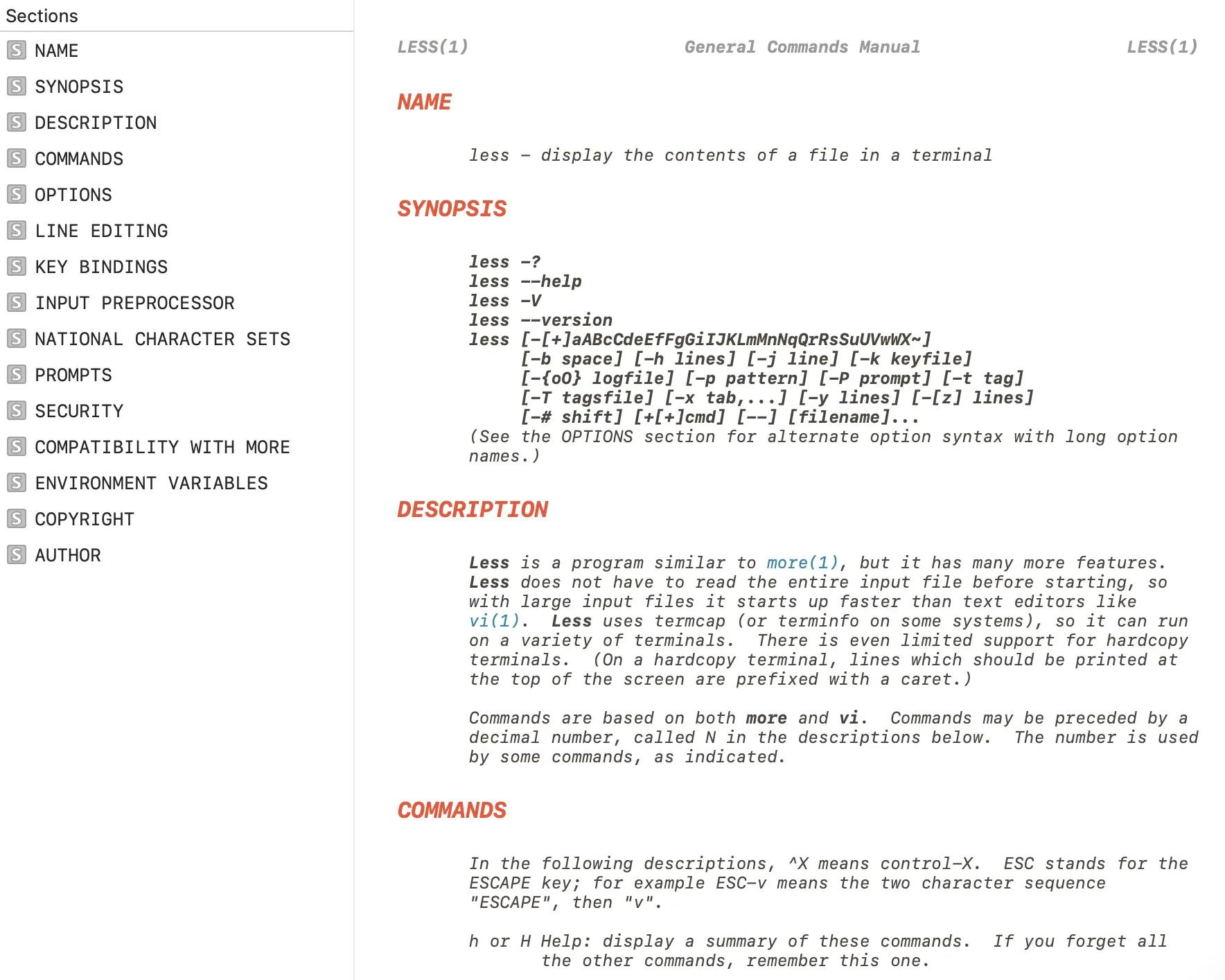
Before making changes, review your existing man page. Look for the SYNOPSIS section – if it lists dozens of options in a single line (like ls [-@ABCFGHILOPRSTUWabcdefghiklmnopqrstuvwxy1%,]), that’s a sign you need to simplify. Identify which options are most commonly used and which are obscure. Also note how the OPTIONS section is organized – is it purely alphabetical? Are there any natural groupings?
Make a list of all options and their current descriptions. This will be the raw material for your new sections.
Step 2: Add an Options Summary Table
Follow the rsync approach: keep your SYNOPSIS extremely terse. For example:
Local: rsync [OPTION...] SRC... [DEST]Then create an OPTIONS SUMMARY section immediately after SYNOPSIS (or as a separate section). This is a compact table (or list) with each option on one line, showing both the long and short form plus a one-line description. For instance:
--verbose, -v            increase verbosity
--info=FLAGS             fine-grained informational verbosity
--debug=FLAGS            fine-grained debug verbosity
--stderr=e|a|c           change stderr output mode (default: errors)
--quiet, -q              suppress non-error messages
--no-motd                suppress daemon-mode MOTD
Use a monospaced font or table formatting to align columns. The summary should cover every option, but keep descriptions to 60 characters or less. Later, the full OPTIONS section will provide detailed explanations.
Step 3: Organize the Options Section by Category
Instead of alphabetically listing all options, group them by functional category. Look at the strace man page for inspiration: it uses categories like “General”, “Startup”, “Tracing”, “Filtering”, and “Output Format”. For your own tool, think about what a user is trying to accomplish (e.g., “Output Control”, “Input Selection”, “Performance Tuning”).
Take the grep example: you could categorize options as:
- Matching Control: -E, -F, -G, -P, -e, -f, -i, -w, -x
- Output Control: -c, -l, -L, -m, -o, -q, -s, -v
- Context Control: -A, -B, -C
- File and Directory: -a, -d, -D, -r, -R, --include, --exclude
- Other: --help, --version, --label, --line-buffered, --null
Within each category, sort options alphabetically. Add a brief introductory sentence for each category. This makes it much easier for a user to find the option they need, especially if they can’t remember the exact flag name.
Step 4: Embed a Compact Cheat Sheet Section
Draw from Perl’s man perlcheat to create a 80-column-wide ASCII cheat sheet. This section should condense the most important syntax, options, and common patterns into a quick-glance table. For example, for a tool like grep, you could have:
BASIC SEARCH
grep pattern file        search for pattern in file
grep -r pattern dir/     recursive search
grep -i pattern file     case-insensitive search
grep -v pattern file     invert match
grep -l pattern *        list files with matches
grep -c pattern file     count matches

ADVANCED
grep -E 'pattern1|pattern2' file   extended regex (alternation)
grep -f patterns.txt file          read patterns from file
grep -o pattern file               only matching text
Keep the cheat sheet tightly formatted – no more than 80 characters wide so it wraps naturally in a terminal. Place this section near the top of your man page (after the OPTIONS SUMMARY) or as an appendix at the end. If your man page already has a section like “EXAMPLES”, you can merge the cheat sheet there.
Step 5: Test and Iterate
After rewriting, view your man page using man -l yourpage.1 or equivalent. Check for:
- Correct formatting and alignment
- No duplicate or missing options
- Logical category groupings
- Cheat sheet fits within 80 columns
Ask a few colleagues to use the man page without hints. Observe where they get stuck or ask questions. Refine categories, adjust descriptions, and re-order the cheat sheet to reflect real-world usage patterns. Iterate until the page feels intuitive.
Conclusion & Tips
By following these steps, your man page becomes more than a reference – it’s a teaching tool and a quick reference guide. Below are additional tips to keep in mind:
- Keep the SYNOPSIS brief – only show the essential invocation syntax. Move all option details to the SUMMARY.
- Use consistent formatting for the summary table: flag (long form first), then short form, then description. Align with spaces or tabs.
- Anchor links – if your man page format supports internal hyperlinks (e.g., using
.URwith groff), link from the summary to the detailed option description. - 80-character width – always test your cheat sheet in an 80-column terminal. Avoid lines that exceed it.
- Gather feedback – put your draft on a public forum (like Hacker News or Reddit) to gather real-world input on what categories make sense.
- Documentation as code – treat your man page source as a living document. Update it every time new options are added.
Remember, the goal is to minimize the time a user spends scanning the man page. A well-designed Options Summary, categorized options, and an embedded cheat sheet can cut that time from minutes to seconds. Happy documenting!
Related Articles
- NVIDIA Opens MRC Networking Standard to All, Boosting AI Factory Performance
- Smartphone Price Surge: OnePlus 15 and Nothing Phone Lead New Wave of Hikes in India
- YouTube Overhauls Google TV Sidebar: Library Access and Recent Channels Take Center Stage
- Crafting Superior Man Pages: A Comprehensive Guide to Enhanced Documentation
- 5 Reasons to Skip the 2026 Motorola Razr and Grab Last Year's Model at a Steal
- 7 Key Insights for Building a High-Performance Telegram Video Downloader with MTProto
- Improving Man Pages: Incorporating Cheat Sheets and Better Organization
- NVIDIA Spectrum-X and MRC: How Open Ethernet Networking Powers Gigascale AI